


24 Well glass bottom plate with #0 cover glass (0.085-0.115 mm)
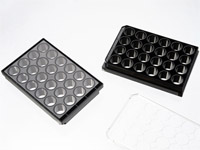
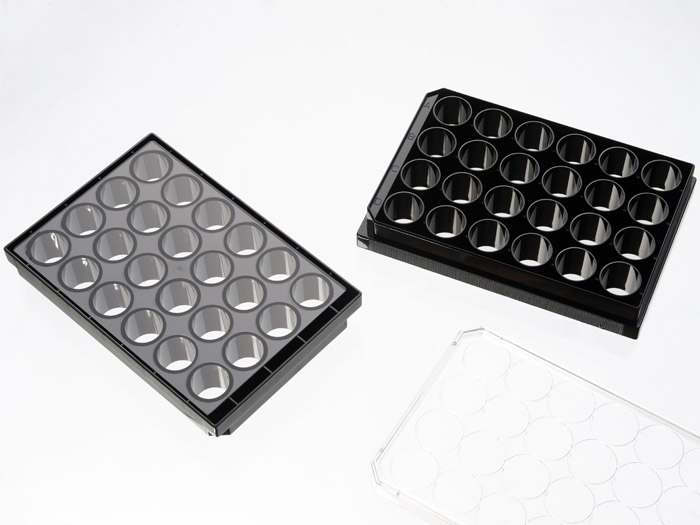
24 well glass bottom plate #0 cover glass (0.085-0.115 mm). Black frame, with lid. Individually packed. Designed for high resolution imaging such as confocal microscopy.
36 cases in stock
** Non-US users please sign in or get a quote to view the proper price for your country.**
Features:
- Suitable for long term tissue culture
- Manufactured in a class 100,000 clean room
- Frame made from virgin polystyrene.
- German high quality cover glass of superior optical quality.
- A USP class VI adhesive is used to assemble the cover glass and the plate.
- Sterilized by Gamma radiation.
- Conforms to ANSI/SBS 1-2004 standards
Suitable for:
- Differential Interference Contrast (DIC)
- Widefield Fluorescence
- Confocal Microscopy
- Two-Photon and Multiphoton Microscopy
- Fluorescence Recovery After Photobleaching (FRAP)
- Förster Resonance Energy Transfer (FRET)
- Fluorescence Lifetime Imaging Microscopy (FLIM)
- Total Internal Reflection Fluorescence (TIRF)
- Super-Resolution Microscopy
Technical specifications
» View technical specification of different coverslips.
| Frame color | black |
|---|---|
| Coverslip | #0 cover glass (0.085-0.115 mm) |
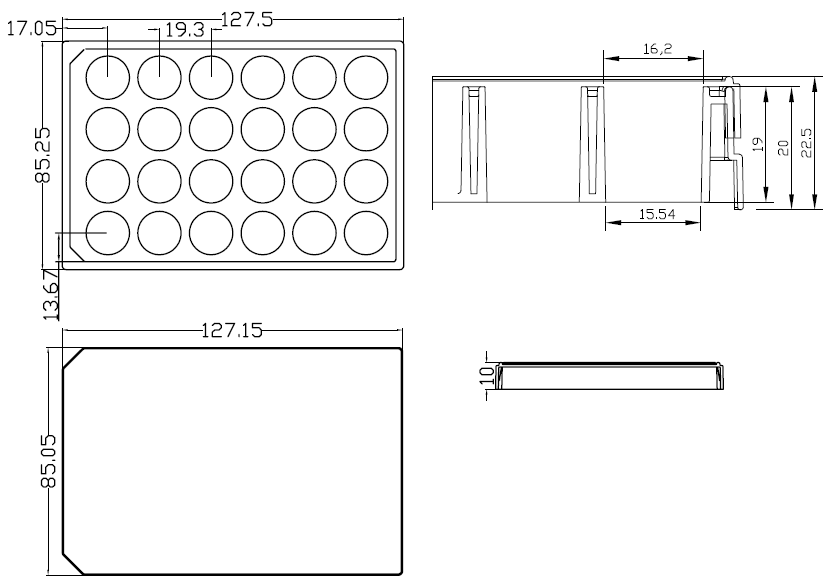
| Length | 127.50 mm |
| Width | 85.25 mm |
| Height | 20 mm |
| Height with lid | 22.5 mm |
| Stacking height (with lid) | 19.5 mm |
| Bottom height | 0.9 mm (bottom of coverslip to plate bottom) |
| Bottom height tolerance | ±50μm (whole plate) |
| Well to well center distance | 19.3 mm |
| Well bottom area | 190 mm2 |
| Maximum volume | 3.6 ml |
| Temperature Range | -20°C to 50°C |
Dimension diagram (units in mm)
Open Source Publications Citing This Product
-
Human neuromodulatory assembloids to study serotonin signaling and disease
S Kanton, X Meng, C Dong, F Birey, D Wang, N Reis - … 2026
… Assembloids were transferred to a well in a 24-well glass bottom plate (Cellvis, P24–0-N) in culture medium, and images were taken using a 10x objective to capture the … -
Microtubule detyrosination enhances matrix remodeling and force transmission during endothelial sprouting
D Mohammed, I Hamid, S Steffens, C Lemeslier - bioRxiv 2026
… P24-0-N), and allowed to polymerize at 24 37 C for 10 min. For imaging chambers, 40,000 HUVECs per chamber were seeded 25 to obtain a confluent monolayer by … -
A human iPSC-based neural spheroid platform for modelling glioblastoma infiltration using high-content imaging
VSK Tsang, F Riccio, AS Wilson, H Nudds - Scientific Reports 2025
Glioblastoma is the most aggressive adult brain tumour, characterised by resistance to therapy and high recurrence due to diffuse infiltration. We developed a …