


96 Well glass bottom plate with #0 cover glass
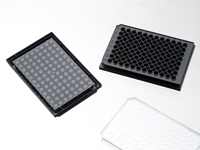
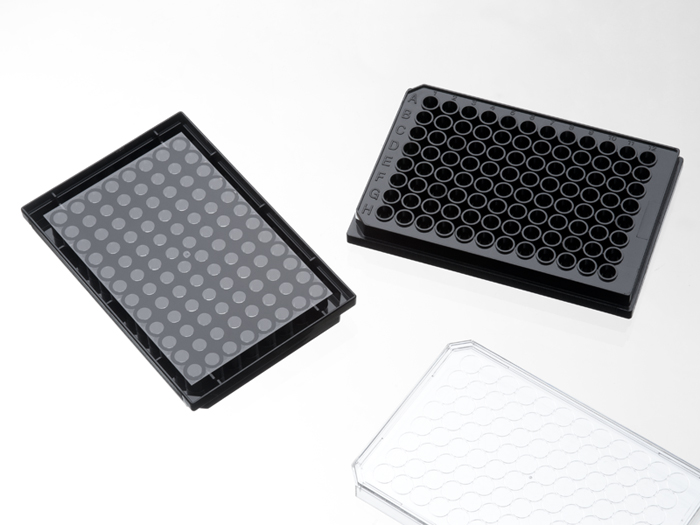
96 well glass bottom plate. Black polystyrene frame with #0 glass(0.085-0.115mm), with lid, Individually packed. Designed for high resolution imaging such as confocal microscopy.
17 cases in stock
** Non-US users please sign in or get a quote to view the proper price for your country.**
Features:
- Suitable for long term tissue culture
- Manufactured in a class 100,000 clean room
- Frame made from virgin polystyrene
- German cover glass of superior optical quality
- A USP class VI adhesive is used to assemble the cover glass and the plate.
- Sterilized by Gamma radiation.
- Conforms to ANSI/SBS 1-2004 standards
Suitable for:
- Differential Interference Contrast (DIC)
- Widefield Fluorescence
- Confocal Microscopy
- Two-Photon and Multiphoton Microscopy
- Fluorescence Recovery After Photobleaching (FRAP)
- Förster Resonance Energy Transfer (FRET)
- Fluorescence Lifetime Imaging Microscopy (FLIM)
- Total Internal Reflection Fluorescence (TIRF)
- Super-Resolution Microscopy
Technical specifications
» View technical specification of different coverslips.
| Frame color | black |
|---|---|
| Coverslip | #0 cover glass (0.085-0.115 mm) |
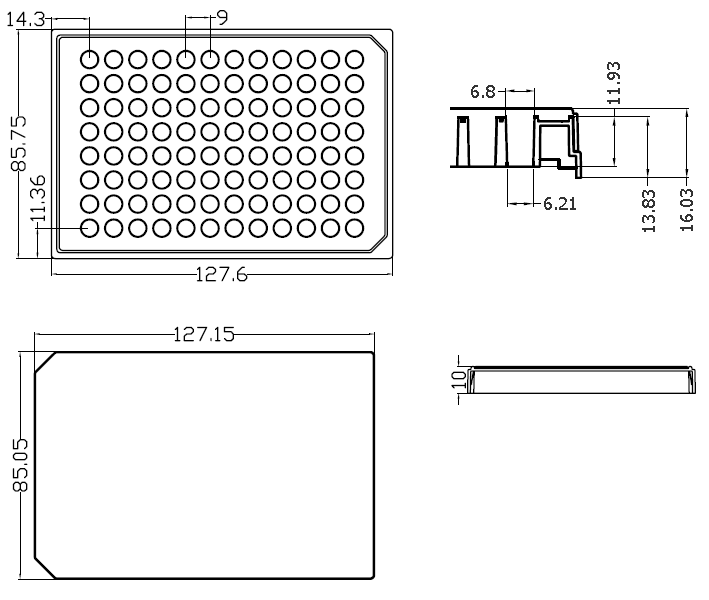
| Length | 127.60 mm |
| Width | 85.75 mm |
| Height | 14.30 mm |
| Height with lid | 16.5 mm |
| Stacking height (with lid) | 15.5 mm |
| Bottom height | 1.8 mm (bottom of coverslip to plate bottom) |
| Bottom height tolerance | ±50μm (whole plate) |
| Lid dimension | 127 * 85 * 10 mm |
| Well to well center distance | 9.00 mm |
| Well bottom area | 30 mm2 |
| Maximum volume | 0.35 ml |
| Temperature Range | -20°C to 50°C |
Dimension diagram (units in mm)
Open Source Publications Citing This Product
-
Mechanisms of Tau Proteostasis Across Development and Neurodegeneration
MR Shin - 2026 2026
Developing human neurons express abundant tau—including phospho-epitopes associated with Alzheimer’s disease (AD)—yet remain resilient to tau-induced toxicity. … -
Cinnamic‐Hydroxamic‐Acid Derivatives Exhibit Antibiotic, Anti‐Biofilm, and Supercoiling Relaxation Properties by Targeting Bacterial Nucleoid‐Associated Protein …
H Chen, Y Xu, Z Xiong, H Wang, X Wang - Advanced … 2026
… Biofilms were allowed to form in a 96-well glass bottom plate (Cellvis, P960-N). 200 μL of … Liu, bioRxiv 2025, 2025. [60] JLN Dinglasan, H. Otani, DT Doering, D. … -
A human iPSC-based neural spheroid platform for modelling glioblastoma infiltration using high-content imaging
VSK Tsang, F Riccio, AS Wilson, H Nudds - Scientific Reports 2025
Glioblastoma is the most aggressive adult brain tumour, characterised by resistance to therapy and high recurrence due to diffuse infiltration. We developed a … -
Adaptive Suppression of MAPT Transcription Maintains Tau Proteostasis in Developing Human Neurons
MR Shin, N Firouzshahi, G Liddiard, M Weis - Research … 2025
… P96–0-N) for 1 hour, protected from light at 37 C. A Bio-Tek plate reader was used to measure proteasome activity, measuring fluorescence activity (ex380 nm and em460 …