


96 Well plate with #1.5 glass-like polymer coverslip bottom, tissue culture treated for better cell attachment than cover glass
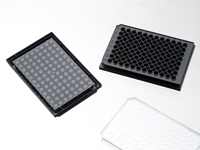
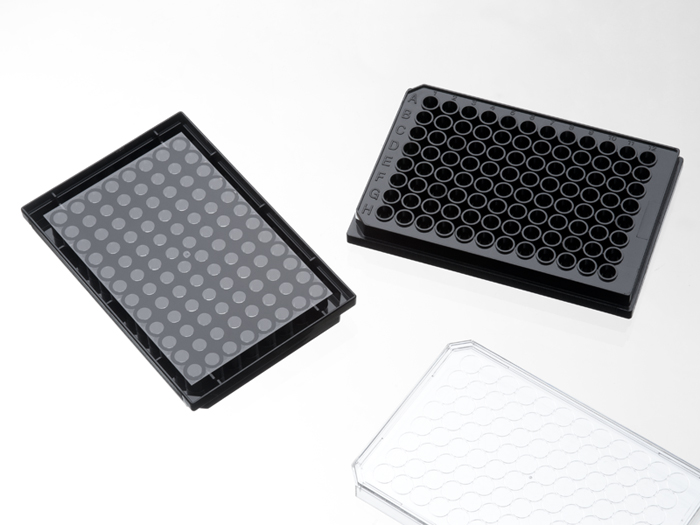
96 well bottom plate with tissue culture treated #1.5 glass-like polymer coverslip (0.175±0.010mm). Tissue culture treated. Black frame with lid. Designed for high resolution imaging such as confocal microscopy.
Recommended for applications where better cell attachment is desired. Not suitable for total internal reflection fluorescence (TIRF).
205 cases in stock
** Non-US users please sign in or get a quote to view the proper price for your country.**
Features:
- Suitable for long term tissue culture
- Frame made from virgin polystyrene.
- Better cell attachment with tissue culture treated #1.5 glass-like polymer coverslip (0.175±0.010mm)
- Manufactured in a class 100,000 clean room
- A USP class VI adhesive is used to assemble the coverslip and the plate.
- Sterilized by Gamma radiation.
- Conforms to ANSI/SBS 1-2004 standards
Suitable for:
- Differential Interference Contrast (DIC)
- Widefield Fluorescence
- Confocal Microscopy
- Two-Photon and Multiphoton Microscopy
- Fluorescence Recovery After Photobleaching (FRAP)
- Förster Resonance Energy Transfer (FRET)
- Fluorescence Lifetime Imaging Microscopy (FLIM)
- Super-Resolution Microscopy
Recommended for:
- Confocal Microscopy
Not suitable for:
- Total Internal Reflection Fluorescence (TIRF)
Technical specifications
» View technical specification of different coverslips.
| Frame color | black |
|---|---|
| Coverslip | #1.5 glass-like polymer (0.175±0.010mm) |
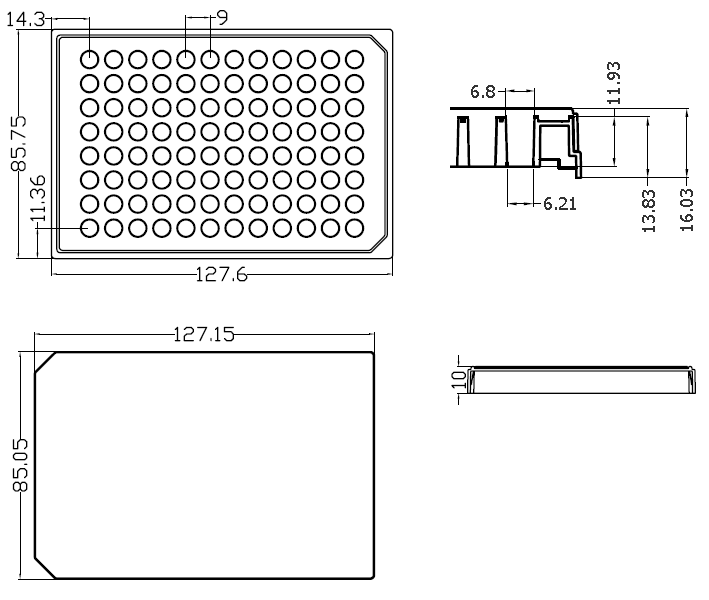
| Length | 127.60 mm |
| Width | 85.75 mm |
| Height | 14.30 mm |
| Height with lid | 16.5 mm |
| Stacking height (with lid) | 15.5 mm |
| Bottom height | 1.73 mm (bottom of coverslip to plate bottom) |
| Bottom height tolerance | ±50μm (whole plate) |
| Lid dimension | 127 * 85 * 10 mm |
| Well to well center distance | 9.00 mm |
| Well bottom area | 30 mm2 |
| Maximum volume | 0.35 ml |
| Temperature Range | -20°C to 50°C |
Dimension diagram (units in mm)
Open Source Publications Citing This Product
-
ELDR-Glo, a biosensor for cell age and quiescence depth
MS Johnson, S Kamath, D Fleifel, T Hill, L Mei, N Das - bioRxiv 2026
… Before imaging RPE,MCF7s, or MCF10as, cells were seeded at low density on glass- 485 bottom plates (Cellvis Ca t#P96-1.5P) in appropriate imaging media (no phenol … -
Synaptic activity controls local exposure of an'eat-me'signal via ANO3-ITPR1 signaling
K Shroff, MC O'Brien, TJ Smith, J Fang, KS Yu - bioRxiv 2026
… CC-BY 4.0 International license available under a (which was not certified by peer review) is the author/funder, who has granted bioRxiv a license to display the preprint in … -
Ionic Exposure History Shapes Inner Nuclear Membrane Voltage and Chromatin Texture Responses
H Sediqi, J Mathews, G De Nola, AKR Lytton-Jean - bioRxiv 2026
… The cells were then cultured at 20 000 cells per well into a 96-well plate (Cellvis, Cat: P96-1.5P) 24 hours prior to imaging. Cells were then stained with Hoechst 33342 (1 … -
Hypoxia Inducible Factor 1a (Hif1a) and Hypoxia in Tendon Development and Disease
S Steltzer - 2026 2026
Tendons and ligaments are collagen-rich tissues required for the transmission of force from muscle to bone or bone to bone, respectively. During postnatal development, … -
Molecular and Structural Characterization Reveals Divergent Extracellular Vesicle Profiles Between Wild Type and Alzheimer's Disease Cerebrocortical Organoids.
A Balistreri, N Turner, J Compher - Biorxiv: the Preprint … 2026
… EV purification samples were diluted to 20 ug of protein in the wells of a 96 well plate 260 (P96-1.5P) with DPBS Ca2+ Mg2+ and 10 µM Thioflavin-T (ThT, EW-88226-62, … -
A TSST-1 structural motif disrupts endothelial programs required for vascular regeneration
SS Tang, O Babatunde, PM Tran, XJ Wu - bioRxiv 2026
Staphylococcus aureus causes profound vascular damage during infection, where it inflicts vascular injury across organs and generates lesions that fail to heal. … -
ATR enforcement of the S/G2 checkpoint prevents premature S phase shutdown and genome instability
MJ McEvoy, JC Saldivar - bioRxiv 2026
… siRNA Transfection Cells were seeded at 20,000 cells per well in glass-bottom 96-well plates (Cellvis P96-1.5P) and reverse-transfected with either non-targeting siRNA (… -
G2-to-G0 cell cycle exit underlies sensitivity to ATR inhibition via the p53-p21-RB1 axis
C Sanchez, CO Marmolejo, J Lee, JC Saldivar - bioRxiv 2026
Ataxia-telangiectasia and Rad3-related (ATR) is an essential DNA damage response kinase that protects genome integrity by controlling cell cycle checkpoints, regulating … -
ChemCell: Chemical Tethering of Large Biomolecules to Cell Surfaces through Diels-Alder Ligation
R Dzijak, S Bellová, A Kovalová, V Šlachtová, M Rahm - bioRxiv 2026
… For microscopic observations cells were seeded on a 96 well plate dish with a glass bottom (Cellvis, P96-1.5P). Upon treatment they were washed and DMEM medium … -
Rab12 is a regulator of mitophagy and mitochondrial homeostasis
T Richbourg, A George, A Bitar, IT Ryde, C Farrell - … 2026
… 96-well plates with a glass-like polymer coverslip bottom (Cellvis, P96–1.5P) were stamped using the Bravo Automated Liquid Handling Platform (Agilent Technologies) … -
Senescence-directed nanotherapy ameliorates fibrosis and overcomes immune exclusion in cancer
C Hinterleitner, VJA Barthet, HV Goldberg, KC Vogt - … 2026
… Cells were resuspended in DMEM supplemented with 10% FBS and 1% PenStrep and seeded at 0.01×10⁶ into a seeded in a 96-well plate (Cellvis, P96–1.5P),that was … -
The Disordered Region of ASXL1 Acts as an Auto‐Regulator Through Condensation
X Fang, Q Li, W Zhang - Advanced Science 2026
… For drug screening, ASXL1-TR-mEGFP U2OS cells were seeded on 96 well glass bottom plates (Cellvis, P96-1.5P), and treated the following day with compounds from … -
Skin-derived α-synuclein strains from PD, DLB, and MSA induce distinct intracellular pathology and neurodegeneration
A Raina, W Wang, JC Gonzalez, X Yan - Journal of Biological … 2026
… Two hundred single cells were plated in 100 μl fresh growth medium per well of a 96-well plate (P96–1.5P, CellVis). Twenty colonies were selected based on growth and … -
Synergistic inhibition of CHK1 and MUS81 to combat replication stress resistance in high-risk neuroblastoma
E Hilgert, C Van Neste, SL Bekaert, F Martens - Scientific reports 2025
High-risk neuroblastoma is a pediatric tumor that originates from immature sympathetic neuroblasts and is characterized by a low mutational burden. Nevertheless, it … -
Intramolecular competition generates pulsatory protein activity shaped by light, temperature, and evolution
ZD Huang, M Forson, W Benman, KH Gardner - … 2025
… Cells were seeded into Cellvis 96 well plates (#P96–1.5P) coated with fibronectin (… was used in 96 well plates (#P96–1.5P CellVis) to prevent overheating from optoplate. … -
Extracellular microRNAs modulate human microglial function through TLR8
H Weidling, E Motta, LD Kuhrt, C Krüger - Frontiers in … 2025
Objective MicroRNAs (miRNAs) are abundantly expressed in the brain and are specifically dysregulated in central nervous system (CNS) diseases. They act as post-…