35 mm Glass bottom dish with 10 mm micro-well #1.5 cover glass
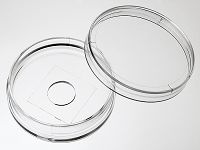
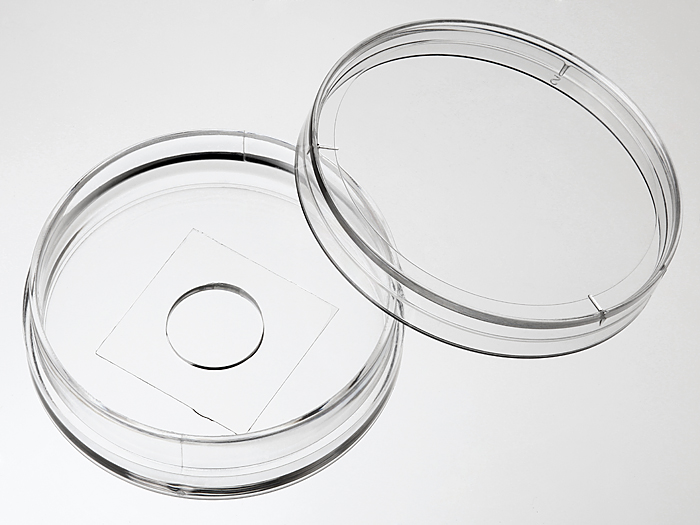
35mm glass bottom dish, dish size 35mm, well size 10mm, #1.5 glass(0.16-0.19mm). Designed for high resolution imaging such as confocal microscopy.
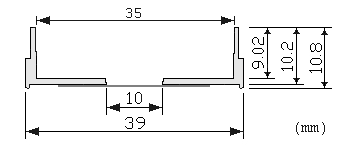
Note: We found that a small percentage of microscope adapters are too small for our 35 mm glass bottom dishes. Please check carefully the dimension diagram. If your adapter is too small, you should use our 29 mm glass bottom dish instead.
30 cases in stock
** Non-US users please sign in or get a quote to view the proper price for your country.**
Features:
- Suitable for long term tissue culture
- Manufactured in a class 100,000 clean room
- Dish made from virgin polystyrene, tissue culture treated.
- German cover glass of superior optical quality
- A USP class VI adhesive is used to assemble the cover glass and the dish.
- Packed in easy to open peelable bag
- Sterilized by Gamma radiation.
Suitable for:
- Differential Interference Contrast (DIC)
- Widefield Fluorescence
- Confocal Microscopy
- Two-Photon and Multiphoton Microscopy
- Fluorescence Recovery After Photobleaching (FRAP)
- Förster Resonance Energy Transfer (FRET)
- Fluorescence Lifetime Imaging Microscopy (FLIM)
- Total Internal Reflection Fluorescence (TIRF)
- Super-Resolution Microscopy
Recommended for:
- Confocal Microscopy
Technical specifications
» View technical specification of different coverslips.
| Coverslip | #1.5 cover glass (0.16 - 0.19 mm) |
|---|---|
| Temperature Range | -20°C to 50°C |
| Lid diameter(outer) | 40 mm |
Dimension diagram (units in mm)
Open Source Publications Citing This Product
-
Ultra-structural analysis of mineralized extracellular matrix in osteogenic monolayers and spheroids: comparison of sample preparation methods
D Boscaro, U Ludacka, P Sikorski - bioRxiv 2026
… D35-10-1.5-N), covered with a GN-6 Metricel® 0.45 µm-47 mm sterile membrane and gelation was induced by adding 50 mM CaCl2 on top of the membrane for 5 minutes… -
Mechanoresponsive modulation of nuclear pore complex structure and function by O-GlcNAc
S Chandra, KJ Morgan, WL Chadwick, MC King - bioRxiv 2026
… Cells expressing GFP or mCherry-based reporters were grown on 35 mm glass bottom dishes (D35-10-1.5-N; CellVis) and incubated with medium lacking phenol-red … -
Co-option of lysosomal machinery shapes the evolution of the intracellular photosymbiosis supporting coral reefs
S Maruyama, CF Henderson, N Swinhoe - Cell 2026
Endosymbiosis has spurred the evolution of new organelles across life. Corals and other cnidarians have repeatedly evolved an organelle, called the symbiosome, which … -
Modeling the cell biology of PEX11β deficiency during human neurogenesis
C Bodnya, RP Theart, V Gama - bioRxiv 2026
… Neural progenitors were generated from iPSCs as described above and plated onto Matrigel-coated 35mm imaging dishes (Cellvis #D35–10-1.5-N). At day 3 of neural … -
Label-free imaging of matrix mineralization in alginate-encapsulated bone spheroids using Coherent Raman Scattering microscopy
D Boscaro, SJ Kjeldgaard-Nintemann - … & Biomedical Imaging 2026
Three-dimensional (3D) cell cultures, such as spheroids, are increasingly used to perform advanced studies on bone matrix mineralization. However, their full …