


4-Chamber 35mm glass bottom dish with 20 mm microwell, #0 cover glass
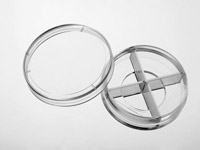
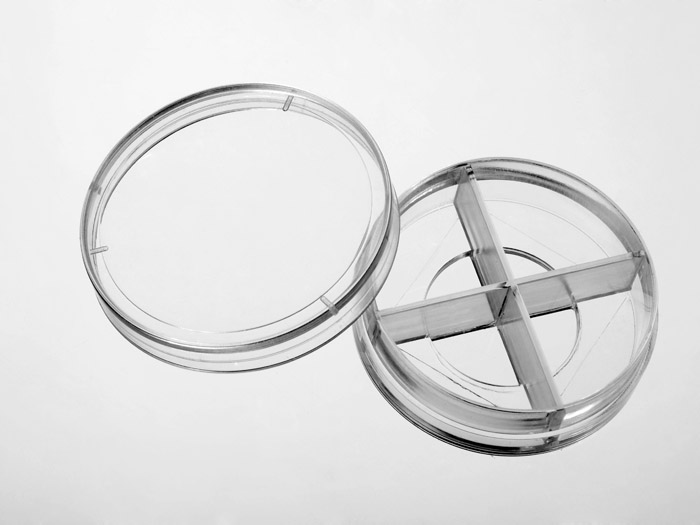
35 mm glass bottom dish with 4 chambers, 20mm microwell, #0 cover glass (0.085-0.115mm). Designed for high resolution imaging such as confocal microscopy.
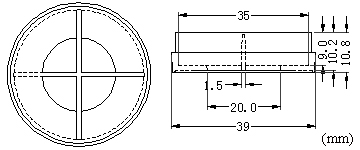
Note: We found that a small percentage of microscope adapters are too small for our 35 mm glass bottom dishes. Please check carefully the dimension diagram. If your adapter is too small, you should use our 29 mm glass bottom dish instead.
46 cases in stock
** Non-US users please sign in or get a quote to view the proper price for your country.**
Features:
- Suitable for long term tissue culture
- Manufactured in a class 100,000 clean room
- Dish made from virgin polystyrene, tissue culture treated.
- German cover glass of superior optical quality
- A USP class VI adhesive is used to assemble the cover glass and the dish.
- Packed in easy to open peelable bag
- Sterilized by Gamma radiation.
Suitable for:
- Differential Interference Contrast (DIC)
- Widefield Fluorescence
- Confocal Microscopy
- Two-Photon and Multiphoton Microscopy
- Fluorescence Recovery After Photobleaching (FRAP)
- Förster Resonance Energy Transfer (FRET)
- Fluorescence Lifetime Imaging Microscopy (FLIM)
- Total Internal Reflection Fluorescence (TIRF)
- Super-Resolution Microscopy
Technical specifications
» View technical specification of different coverslips.
| Coverslip | #0 cover glass (0.085-0.115 mm) |
|---|---|
| Temperature Range | -20°C to 50°C |
| Bottom Cover Glass Area | 2.56 cm2 (0.64 cm2 per quarter) |
Dimension diagram (units in mm)
Open Source Publications Citing This Product
-
Simple and Multiplexed Tracking of Bacterial Growth in Double Emulsion Droplets
S Somolinos Cedeño, S Thompson, P Fordyce, D Endy - bioRxiv 2026
… To prototype a simple implementation of a trap-less imaging set-up, we used a glass bottom dish (D35C4-20-0-N, Cellvis) and increased the relative volume of the outer … -
A Commensal-Derived Lipoteichoic Acid Engages an Inducible Neuronal PD-1 Checkpoint to Suppress Inflammatory Pain
Z Liu, YH Cheng, CV Osborn, M Martina, AJ Schaeffer - bioRxiv 2026
Background Immune checkpoint receptors regulate adaptive immunity but are increasingly recognized as modulators of neuroimmune interactions. The upstream signals … -
Myofibroblasts slow down defect recombination dynamics in mixed cell monolayers
Z Zheng, Y Luo, J Chen, Y Luo - arXiv preprint arXiv:2512.22923 2025
Cellular organization and mechanotransduction pathways are crucial regulators of tissue morphogenesis, whereas their dysregulation contributes to pathologies. …